Personalized Medicine with NFC Authentication
In this new series “Hybrid Product Ideas with Qliktag” we share some interesting ideas and examples of ordinary physical products and assets, addressing how their value can be enhanced by tokenizing and digitally augmenting them through the use of printed electronic tags. This series aims to explore the intersection of technology and personalized experiences, particularly in the context of healthcare and medicine.
Today, we look into personalized medicine.
Personalized medicine and customized delivery of drugs and medical treatments is rapidly gaining ground within the medical, healthcare, and pharmaceutical world. Rather than prescribing generic drugs and treatments, the practice of personalizing treatment decisions, medicine components, and dosage specifically for an individual’s medical profile, specific condition, body type, reactions, and individual traits is advancing healthcare. For example, a patient with a unique genetic makeup may respond differently to a standard medication compared to a typical patient. Therefore, personalized medicine aims to tailor treatments to achieve the best outcomes.
With personalized medicine, products and doses linked to specific patients come with unique challenges that can be addressed through the tokenization of doses, linking physical medicine doses to specific patients digitally, ensuring safety and security through NFC technology, and maintaining traceability and accountability on the blockchain with NFT tokens.
Let’s imagine a personalized medicine glass vial container with a cancer drug customized with components and dosage for treatment tailored specifically for a patient. Unlike generic drugs that may not account for individual variances, this formulation is carefully created for a particular patient, ensuring safety and efficacy.
For instance, a particular chemotherapy drug may require different dosages based on the patient’s weight and metabolic rate. Ensuring accountability, delivery to the right person, being able to authenticate the dose, confirm it is in the custody of the right person, and maintain an immutable traceability record all become crucial factors. Similarly, communicating the right dosage and customized instructions to specific patients for specific doses also becomes relevant as failure to do so can lead to severe health implications.
Now, picture the glass vial container with the same personalized drug equipped with a printed electronic / NFC tag embedded into the container. This allows a patient to tap the NFC chip, authenticate the drug, and verify without doubt that it was formulated specifically for them. This innovative technology also enables the patient to reorder future doses with ease, report effects and progress, access personalized dose administration instructions, and receive reminder notifications when it is time to take a dose. Imagine a scenario where a patient receives real-time updates regarding their treatment, allowing them to feel more in control of their health.
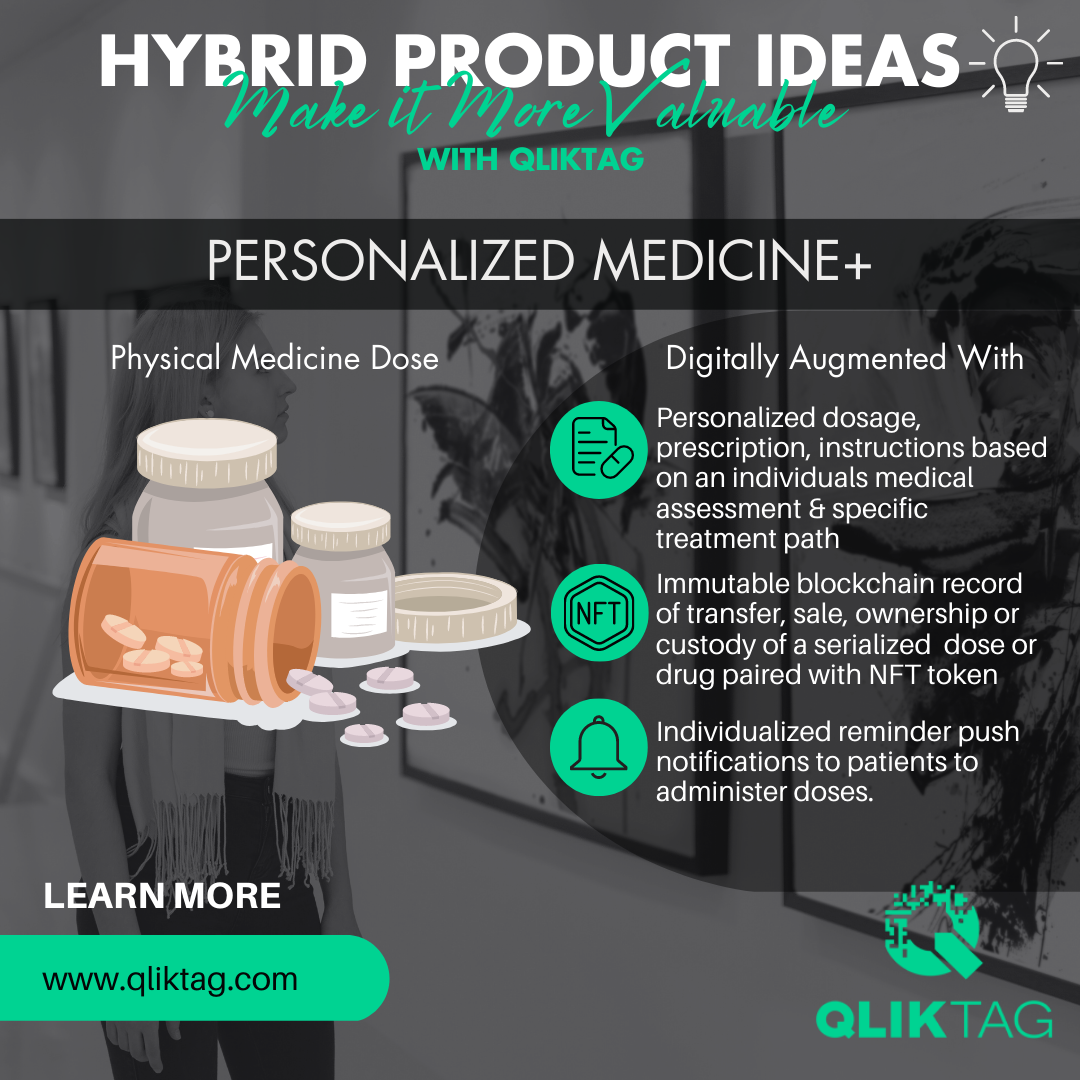
The medicine equipped with a Qliktag NFC chip can be digitally augmented with:
- Digital authentication of the medicine / dose through the use of secure, unclonable & verifiable NFC within the individual packaging which uses changing encrypted keys to ensure the authenticity of the medicine prevention of counterfeiting, preventing mix ups which is critical to safety.
- An immutable record of who this medicine dose is authorised for use can be maintained on the blockchain by pairing the dose with an NFT token. This token can be used to verify the patient, unlock features to re-order further doses of the same personalized treatment, unlock ways for the patient to submit feedback and treat progress back and gate certain features or content which should be exclusively for the authorised patient.
- Personalized dosage, component / ingredient lists, allergy warnings, instructions for administering the medicine, treatment instructions based on the individuals medical assessment.
- Push notifications to remind the patient to administer a dose of the medicine or updates on expiry or changes to treatment instructions based on the medical experts assessment of how the treatment is progressing.
Tokenization and augmenting physical doses of personalized medicine with digital features can make the medicine significantly more valuable but more importantly, safer, smarter and even more personalized.
The potential for personalized medicine is vast as it evolves with technology. Increased collaboration between tech developers, healthcare providers, and pharmaceutical companies can pave the way for groundbreaking advancements. Continuous research and development will contribute to the effectiveness of personalized treatments, making healthcare not only more efficient but also more responsive to individual patient needs.
Moreover, educating patients about the importance of personalized medicine empowers them to take a more active role in their healthcare decisions. Patients who understand how their treatments are tailored to their specific needs are more likely to adhere to prescribed regimens, leading to better health outcomes. Healthcare providers can facilitate this education, offering resources that explain the benefits of personalized medicine and how it contrasts with traditional one-size-fits-all approaches.
Furthermore, by utilizing blockchain technology, we can ensure that all patient data is secure and private, only accessible by authorized individuals. Each interaction with the medicine, from its production to administration and follow-up, can be recorded, creating a comprehensive medical history for each patient. This not only enhances transparency but also builds trust between patients and healthcare providers, ensuring that patients feel confident in the safety and efficacy of their personalized treatments.
The integration of technology in personalized medicine does not stop here. Future advancements may include AI-driven analytics that can predict a patient’s response to medication based on historical data, further refining personalized treatment plans. Additionally, telemedicine capabilities can enhance patient-provider communication, allowing for timely adjustments in treatment as needed. These innovations significantly improve patient engagement, adherence, and overall outcomes, marking a new era in healthcare.
As we move forward, the application of personalized medicine will undoubtedly reshape how we approach healthcare. By combining innovative technologies such as NFC and blockchain, we can create a safer, smarter, and more efficient healthcare system that prioritizes patient individuality and safety, paving the way for a future where personalized medicine becomes the standard in medical treatment.